Lesson 2.1 - Introduction to Forces
VIDEO LESSON (24:11 min)
Video is not accessible in some countries. If you cannot view it, you might need VPN to do so.
Dynamics: Why things move
Things move because they are "pushed" or "pulled" by FORCES
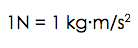
Force is a vector quantity measured in Newtons (N)
The product of the avearge force exerted and the time interval is called the impulse.
Gravity Force
The first force we will investigate is that due to gravity, and we'll call it the gravitational force. We know that the acceleration due to gravity (if on Earth) is approximately g \( =9.8 m/s^2 \). It is always pointing toward the centre of Earth.
Normal Force
This force is one which prevents objects from 'falling' into whatever it is sitting upon. It is always perpendicular to the surface with which an object is in contact.


Friction Force
Frictional force is parallel to the surface in contact with the object. Friction opposes motion, and so its vector always points away from the direction of movement.


Applied Force
Any physical push or pull caused by a person or wind/air.

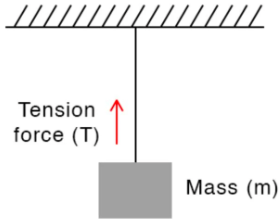
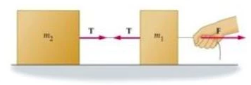
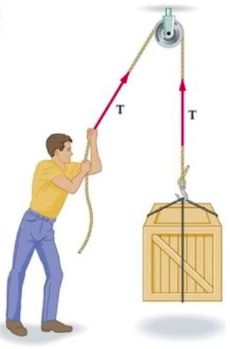
Tension Force
Tension in an object results if pulling force act on its ends, such as in a rope/wire. If no force are acting on the rope/wire and the rope/wire itself is in equilibrium, then the tension is the same throughout the rope.
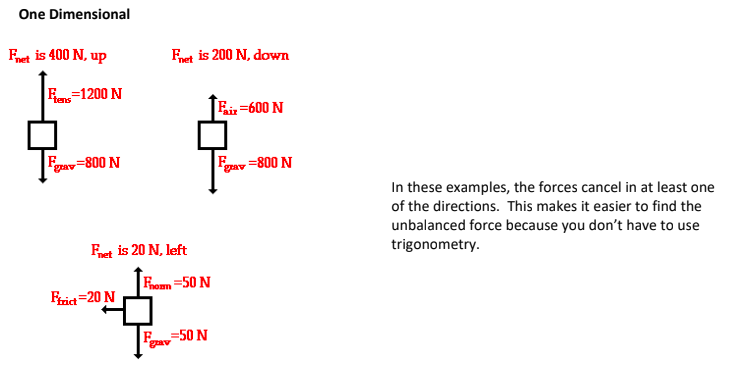
Net Force
is the vector sum of all the forces which act upon an object.
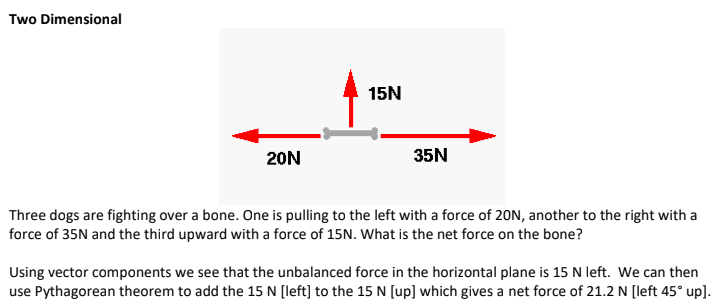
SOLUTION:
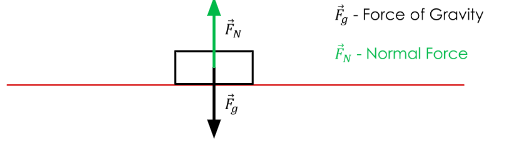
SOLUTION:
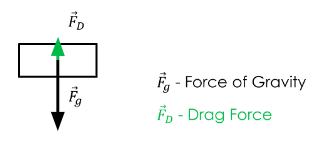
SOLUTION:
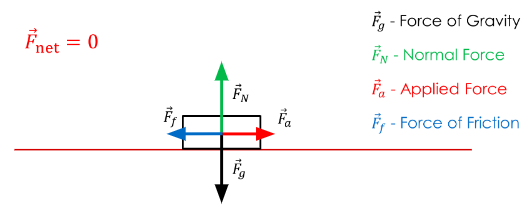
Video is not accessible in some countries. If you cannot view it, you might need VPN to do so.
DEFINITIONS
Kinematics: How things moveDynamics: Why things move
Things move because they are "pushed" or "pulled" by FORCES
Force is a vector quantity measured in Newtons (N)
EXAMPLES:
- Friction
- Pushing/Pulling on something
- Electrical forces
- Magnetic forces
- Gravity
- Elastic force
- Weight
The product of the avearge force exerted and the time interval is called the impulse.
- GRAVITY - The force that attracts anything with mass

- ELECTROMAGNETIC - The force that attracts or repels electric charges

- STRONG NUCLEAR - The force that keeps nucleons (protons and neutrons together)

- WEAK NUCLEAR - The force that causes nucleons to change flavour that leads to nuclear radiation (\( \alpha, \beta, \gamma \) rays)

(- Higgs "force") The "force" that gives masses inertia ... kinda ...
FREE BODY DIAGRAMS (FBD)
To show the forces acting on an object we use a simplified diagram with the forces show as vectors.Gravity Force
The first force we will investigate is that due to gravity, and we'll call it the gravitational force. We know that the acceleration due to gravity (if on Earth) is approximately g \( =9.8 m/s^2 \). It is always pointing toward the centre of Earth.
Normal Force
This force is one which prevents objects from 'falling' into whatever it is sitting upon. It is always perpendicular to the surface with which an object is in contact.
Friction Force
Frictional force is parallel to the surface in contact with the object. Friction opposes motion, and so its vector always points away from the direction of movement.
Applied Force
Any physical push or pull caused by a person or wind/air.
Tension Force
Tension in an object results if pulling force act on its ends, such as in a rope/wire. If no force are acting on the rope/wire and the rope/wire itself is in equilibrium, then the tension is the same throughout the rope.
Net Force
is the vector sum of all the forces which act upon an object.
EXAMPLE #1
Draw FBD for an object on your deskSOLUTION:
EXAMPLE #2
Draw FBD for a falling objectSOLUTION:
EXAMPLE #3
Draw FBD for an object on your desk being pushed at constant speedSOLUTION:
Sửa lần cuối: Thứ sáu, 27 Tháng 2 2026, 8:12 PM