Lesson 2.3 - Friction
VIDEO LESSON (22:00 min)
Video is not accessible in some countries. If you cannot view it, you might need VPN to do so.
FRICTION
Friction is a force that oppposes motion by generating a foce in the opposite direction of an object's motion. For example:
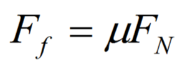
The magnitude of the force of friction is proportional to the normal force acting on the object by the surface it is on. The proportionality constant, \( \mu \), is the coefficient of friction. This depends on the materials that are in contact.
SOLUTION:
SOLUTION:
Video is not accessible in some countries. If you cannot view it, you might need VPN to do so.
FRICTION
Friction is a force that oppposes motion by generating a foce in the opposite direction of an object's motion. For example:
- mechanical friction (sliding)
- rolling friction
- fluid friction (air resistance)
ANALYSIS OF SLIDING FRICTION
The magnitude of the force of friction is proportional to the normal force acting on the object by the surface it is on. The proportionality constant, \( \mu \), is the coefficient of friction. This depends on the materials that are in contact.
EXAMPLE PROBLEM #1
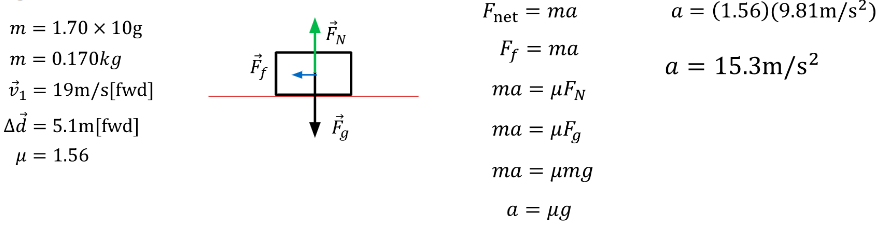
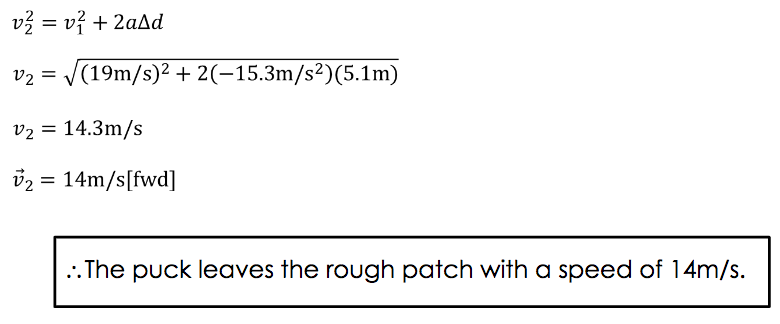
A \( 1.70 /times 10^2 g \) puck slides on an ice rink at 19 m/s [fwd] when it hits a 5.1 m rough patch. The coefficient of friction between the puck and the rough ice is 1.56. Calculate the velocity of the puck as it leaves the rough ice.SOLUTION:
EXAMPLE PROBLEM #2
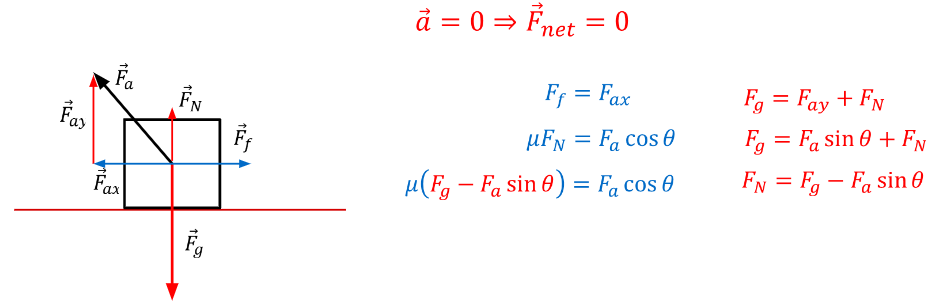
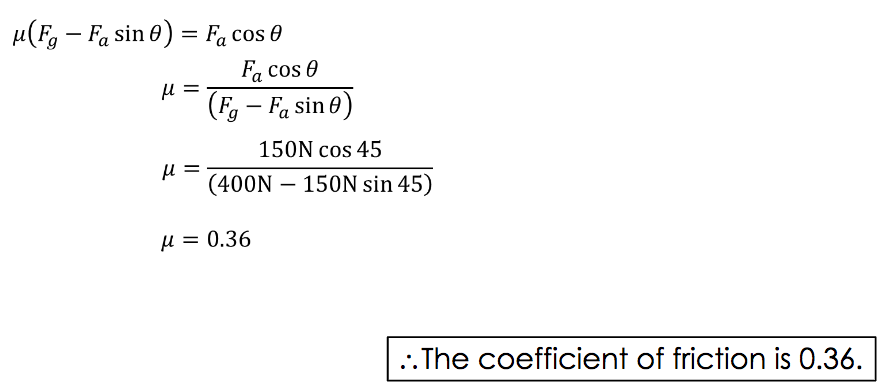
A crate weighing \( 4.0 \times 10^2 N \) is pulled along a horizontal sidewalk at constant speed by a rope that makes an angle of \( 45^o \) with the sidewalk. If a force of \( 150 N \) is applied to the rope, what is the coefficient of sliding friction?SOLUTION:
Modifié le: dimanche 1 mars 2026, 13:19